Claude Opus 5.5 Explained: Fable-Level AI for 40% Less - and What It Means for Your Job
September 23, 2026
Executive Intelligence Summary
- 01
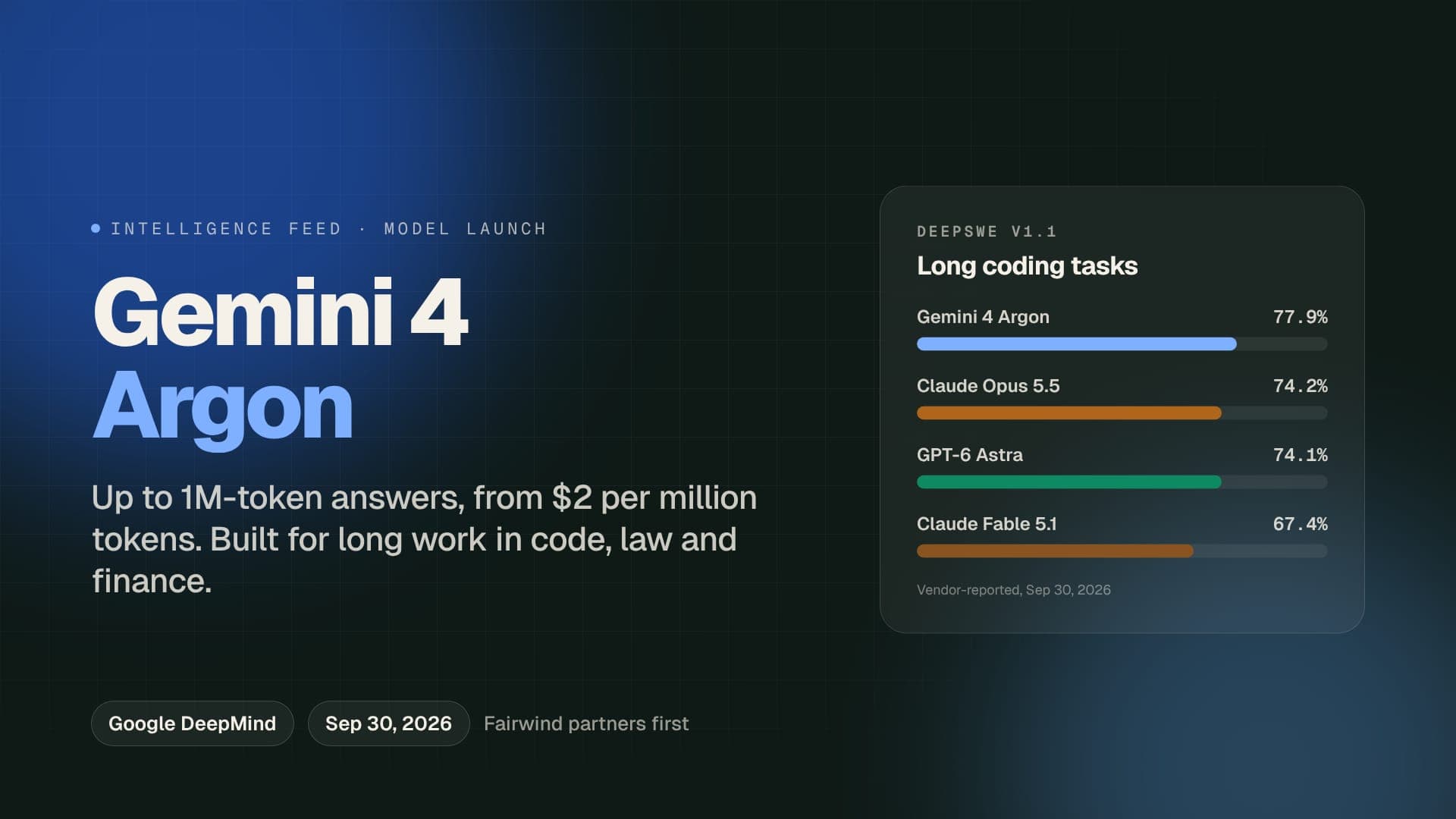
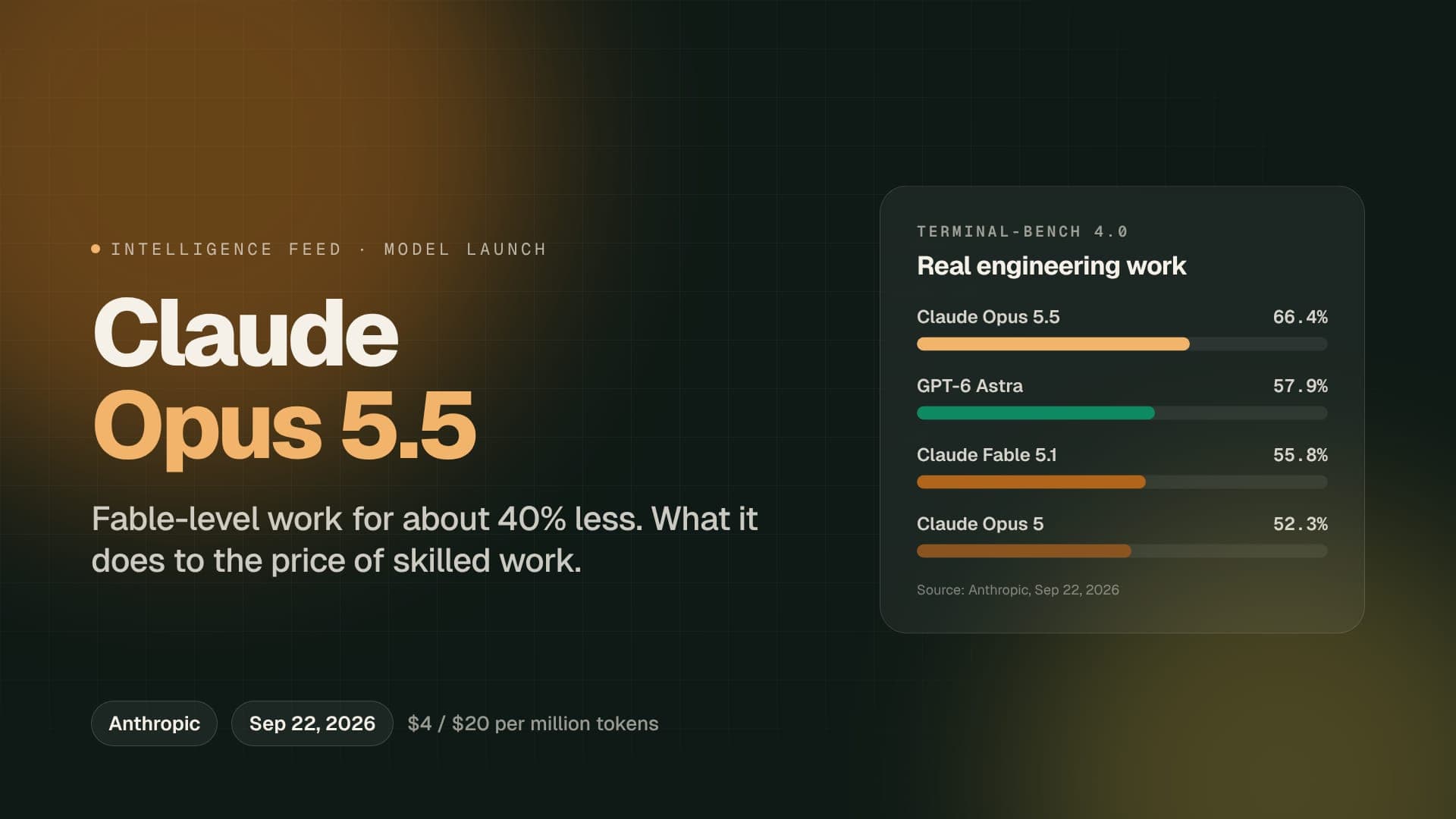
Claude Opus 5.5 launched on September 22, 2026 as the first model in the Claude 5.5 family. Anthropic says it works at the level of its top model, Claude Fable 5.1, on most tasks - and costs about 40% less to run than Opus 5.
- 02
It leads the field on Terminal-Bench 4.0 (66.4% against 57.9% for GPT-6 Astra) and on GDPval-AA, a test built from real professional work (1846 Elo against 1542 for Astra).
- 03
In early real-world tests it finished a 680,000-line code migration in under a day, and audited and fixed a 200,000-line codebase in under three hours - work that took Opus 5 more than 20.
- 04
The price fell to $4 per million input tokens and $20 per million output (from $5 and $25). Cheaper skilled work is the part of this launch that changes hiring maths.
On September 22, 2026, Anthropic released Claude Opus 5.5, the first model in the new Claude 5.5 family. Smaller siblings, Claude Sonnet 5.5 and Claude Haiku 5.5, are due "in the coming weeks".
The short version fits in one sentence: Anthropic says Opus 5.5 works at the level of its most capable model, Claude Fable 5.1, on most tasks - and costs about 40% less to run than the Opus 5 it replaces.
That second half is the part to watch. Every time skilled AI work gets cheaper, a few more tasks cross the line from "interesting demo" to "cheaper than a person". This article walks through what Opus 5.5 can do, what it costs, how it compares with GPT-6 Astra, and what it means for your job - without the jargon.
Claude Opus 5.5 in 60 seconds
| Question | Short answer |
|---|---|
| Released | September 22, 2026 |
| Made by | Anthropic |
| What it is | The first Claude 5.5 model; Sonnet 5.5 and Haiku 5.5 follow |
| How smart | Fable 5.1 level on most work, according to Anthropic |
| Price (API) | $4 per million input tokens, $20 per million output |
| Speed | Output more than 30% faster than Opus 5; a fast mode is up to 2.5x faster |
| Where to use it | Claude apps (Pro, Max, Team, Enterprise), Claude Code, the API, AWS, Google Cloud and Azure |
What is a token? A token is a small chunk of text - roughly three-quarters of a word. A million tokens is about 750,000 words, or several long novels. Prices for AI models are quoted per million tokens.
The benchmarks, in plain English
Benchmarks are standard tests that let you compare AI models on the same tasks. Anthropic published nine. Here are the ones that look most like real jobs.
Claude Opus 5.5 leads on real engineering work
Three tests of software work done the way engineers actually do it - in a terminal, on a real codebase, inside a coding tool. Higher is better.
- GPT-6 Astra (OpenAI)
- GPT-5.6 Sol (OpenAI, prior gen)
- Anthropic
Terminal-Bench 4.0
Engineering, setup and data work done in a command line. The biggest lead in the launch.
FrontierCode v1.1 (Main)
Hard, open-ended coding problems. A close race at the top.
CursorBench 4.0
Real tasks inside the Cursor coding editor.
Source: Anthropic, Claude Opus 5.5 launch page (September 22, 2026). Scores as reported by Anthropic; a dash on Anthropic's table means no score was given, so that model is left out of the panel.
Terminal-Bench 4.0 is the headline. It measures engineering work done in a command line - setting up systems, fixing builds, moving data. Opus 5.5 scores 66.4%, almost nine points clear of GPT-6 Astra at 57.9%. That is the biggest lead in the whole launch. On FrontierCode, a test of hard open-ended coding problems, the race is much closer: 54.4% against 53.3%.
The test closest to an ordinary office job is GDPval.
Office work: the score that maps onto real jobs
GDPval-AA scores models on real work tasks drawn from professional jobs, rated like chess players (Elo). Higher is better, and 100 points is a large gap.
- GPT-6 Astra (OpenAI)
- GPT-5.6 Sol (OpenAI, prior gen)
- Anthropic
GDPval-AA v2.1 (Elo rating)
Source: Anthropic, Claude Opus 5.5 launch page (September 22, 2026), GDPval-AA v2.1.
GDPval is built from real work tasks taken from professional jobs - the reports, analyses and documents people are paid to produce. Models are rated against each other like chess players. Opus 5.5 scores 1846, more than 100 points above its own big brother, Fable 5.1, and 300 above GPT-6 Astra.
It does not win everything, and that matters too.
Using a computer like a person - and where it does not win
OSWorld asks a model to finish real tasks in real desktop apps. AutomationBench runs multi-step business workflows. Higher is better.
- GPT-6 Astra (OpenAI)
- GPT-5.6 Sol (OpenAI, prior gen)
- Anthropic
OSWorld 2.1 (partial)
AutomationBench
The one business-workflow test where GPT-6 Astra stays ahead.
Source: Anthropic, Claude Opus 5.5 launch page (September 22, 2026). OSWorld 2.1 is a partial run; Anthropic gave no OSWorld scores for the OpenAI models.
On OSWorld 2.1, which asks a model to finish real tasks inside desktop apps, Opus 5.5 reaches 81.8%. On AutomationBench, which runs multi-step business workflows, GPT-6 Astra is still just ahead at 41.4% to 40.0%. And Anthropic itself warns that at this level, benchmark margins are a less reliable guide than they used to be.
Free · about 30 seconds
Your job is a list of tasks. Which ones could Opus 5.5 do?
Upload your resume and get your AI Job Security Score, the tasks most at risk and the strengths that protect you.
The real-world tests matter more than the scores
Scores tell you who wins a test. The examples Anthropic and its early testers shared tell you what changes on a Monday morning.
- A 680,000-line code migration in under a day. One early tester moved a codebase of that size in a single working day.
- A 200,000-line codebase audited and fixed in under three hours. Opus 5 needed more than 20 hours for the same job, and 2.5 times as many tokens.
- Research reports that pass review. In an internal test, 16 of 18 research reports written by Opus 5.5 cleared Anthropic's quality bar. Neither Fable 5.1 nor Opus 5 cleared it in any attempt.
- A merger financial model in 63 minutes instead of 93, at half the cost.
- Clearer writing. Anthropic says Opus 5.5 puts the key point first. One early tester's verdict: "it writes the way I do."
The same work, on the clock
Hours to finish real jobs given to the models by Anthropic and early testers. Lower is better - this is the number that turns a capability into a staffing decision.
Audit and fix a 200,000-line codebase
Opus 5 also used 2.5 times as many tokens.
Translate HAProxy from C to Rust
Opus 5.5 also cost 51% less.
Build a merger financial model
At 50% lower cost.
Source: Anthropic, Claude Opus 5.5 launch page (September 22, 2026): an early tester's 200,000-line codebase audit, Anthropic's internal HAProxy C-to-Rust translation, and an internal merger-model test.
Look at the first panel again. A job that took the previous model more than 20 hours now takes an afternoon. When the time drops that far, a manager stops asking "can AI help with this?" and starts asking "do we still need to staff this?"
"I'm struggling to find anything negative to say." - Sean Heintz, Clio
The price drop is the real story
| Price per million tokens | Claude Opus 5.5 | Claude Opus 5 |
|---|---|---|
| Input | $4 | $5 |
| Output | $20 | $25 |
| Cached input (reads) | $0.20 | $0.50 |
| Fast mode (input / output) | $8 / $40 | - |
The sticker price fell by a fifth. The real saving is bigger, because Opus 5.5 also finishes tasks in fewer steps: Anthropic puts the total at about 40% cheaper than Opus 5 on typical work, and its HAProxy translation test came in 51% cheaper than Fable 5.1.
Here is why that matters for careers. Companies do not automate a task because a model *can* do it. They automate it when the model does it cheaper than a person, reliably. Every price cut moves more tasks over that line - without the model getting any smarter.
Claude Opus 5.5 vs GPT-6 Astra
GPT-6 Astra, released by OpenAI on September 3, was the model to beat. Here is how the two compare on the tests Anthropic published.
| Test | Claude Opus 5.5 | GPT-6 Astra | Winner |
|---|---|---|---|
| Terminal-Bench 4.0 | 66.4% | 57.9% | Opus 5.5 |
| FrontierCode v1.1 | 54.4% | 53.3% | Opus 5.5 (close) |
| GDPval-AA (Elo) | 1846 | 1542 | Opus 5.5 |
| Humanity's Last Exam (with tools) | 67.7% | 57.2% | Opus 5.5 |
| AutomationBench | 40.0% | 41.4% | Astra (close) |
| Terminal-Bench-Science | 58.7% | 64.6% | Astra |
| Price (input / output) | $4 / $20 | $10 / $50 | Opus 5.5 |
The honest summary: Opus 5.5 is the stronger and cheaper choice for most engineering and office work; Astra keeps an edge on science and some automation tasks. For your career the more important point is that two labs are now neck and neck at the top - so companies can switch between them, and prices keep falling.
Is Claude Opus 5.5 safe?
Anthropic published more safety detail than most launches carry:
- It scored the best of any model Anthropic has tested on its automated behaviour audit.
- In a new test, it tried to get around its limits about 85% less often than Opus 5.
- It often suspects when it is being tested, which Anthropic flags because it makes testing harder.
- Most cybersecurity tasks are routed to an older model, Opus 4.8, as a precaution.
What Claude Opus 5.5 means for your job
Read the exposure off the evidence, not the hype.
| Work pattern | What Opus 5.5 showed | Exposure |
|---|---|---|
| Code migrations, audits and bug fixing | 680,000 lines in under a day; 200,000-line audit in under 3 hours | Critical |
| Research reports and analysis | 16 of 18 reports cleared the quality bar | High |
| Financial models and spreadsheets | Merger model in 63 minutes at half the cost | High |
| Routine work inside desktop apps | 81.8% on OSWorld 2.1 | High |
| First drafts of emails, memos and docs | "It writes the way I do" | High |
| Deciding what to build, owning results, client trust | Not measured by any test here | Lower |
Notice the pattern. The exposed work all has a clear finish line: the code compiles, the report passes review, the model balances. The protected work is the part where someone has to decide what "done" means, and answer for it.
What to do this month
- List your week. Write down the five tasks that take most of your time. Mark each one that has a clear finish line. If that is more than half your week, the table above is about you.
- Use the tool on your own work. Try Opus 5.5, or a model like it, on one real task. You learn its limits in an hour, and "knows how to direct AI" is fast becoming a hiring filter.
- Move up a level. The model executes. You decide what is worth doing, check the result, and own it with the people who care. Those three jobs are not on any benchmark.
- Get your number. Know which of your tasks are exposed and which strengths protect you - then build a plan around them.
Your 6-month plan
Get a plan for the Claude 5.5 era
Answer 12 short questions. We research your job market live and write a plan for you, month by month.
Claude Opus 5.5 is not the end of anyone's career. It is another notch on a dial that keeps turning: the same work, done faster, for less. The people who do well are the ones who notice the dial moving - and move first.
Applying is 12 minutes of typing you've already done.
Job Autofill fills every application from your saved profile - about 10 hours back over a job hunt.
Professional Defense Strategy
6-Month Strategic Action Plan
Write down the five tasks that fill most of your week, then mark the ones with a clear finish line - a migration, a report, a model, a fix. Those are the tasks Opus 5.5 was tested on, and the ones a manager can now price.
Use Opus 5.5 (or a model like it) on one of your own tasks this week. People who direct these tools well are being hired; people who only compete with them are not.
Move your value toward the parts no benchmark measures: deciding what is worth doing, checking the output, and owning the result in front of a client or a boss.
Check your own exposure before your employer does. A free AI Job Security Score shows which of your tasks are most at risk and which strengths protect you.
Frequently Asked Questions
What is Claude Opus 5.5?
Claude Opus 5.5 is an AI model made by Anthropic, released on September 22, 2026. It is the first model in the Claude 5.5 family. Anthropic says it performs at the level of Claude Fable 5.1, its most capable model, on most work, while costing about 40% less to run than Claude Opus 5. Claude Sonnet 5.5 and Claude Haiku 5.5 are due in the following weeks.
How much does Claude Opus 5.5 cost?
Through the API, Claude Opus 5.5 costs $4 per million input tokens and $20 per million output tokens, down from $5 and $25 for Opus 5. Cached input reads cost $0.20 per million. A fast mode runs up to 2.5 times faster in Claude Code and on the Claude Platform for $8 input and $40 output per million tokens. A token is roughly three-quarters of a word.
Is Claude Opus 5.5 better than GPT-6 Astra?
On most knowledge-work and engineering tests Anthropic published, yes. Opus 5.5 scores 66.4% on Terminal-Bench 4.0 against 57.9% for GPT-6 Astra, 1846 against 1542 on GDPval-AA, and 67.7% against 57.2% on Humanity's Last Exam with tools. GPT-6 Astra stays ahead on AutomationBench (41.4% against 40.0%) and Terminal-Bench-Science (64.6% against 58.7%). Opus 5.5 is also cheaper: $4 and $20 per million tokens against Astra's $10 and $50.
Is Claude Opus 5.5 better than Claude Fable 5.1?
On Anthropic's own benchmark table, Opus 5.5 scores above Fable 5.1 on every test listed, for example 66.4% against 55.8% on Terminal-Bench 4.0. Anthropic is careful to add that benchmark margins are a less reliable guide at this level, and that the gap is narrower in its own use than the scores suggest. The practical difference is price: Opus 5.5 does Fable-level work at Opus prices.
Where can I use Claude Opus 5.5?
In the Claude apps on the Pro, Max, Team and Enterprise plans, in Claude Code, and through the Claude API with the model name claude-opus-5-5. It is also available on Amazon Web Services, Google Cloud and Microsoft Azure. Anthropic raised the five-hour usage limits on its paid plans at launch.
What is GDPval and why does it matter for my job?
GDPval is a test built from real work tasks taken from professional jobs - the kind of documents, analyses and deliverables people are paid to produce. GDPval-AA scores models against each other like chess ratings. It matters because it is closer to an actual office job than a puzzle benchmark: Opus 5.5 scored 1846, the highest of any model Anthropic compared.
Will Claude Opus 5.5 replace my job?
Models like Opus 5.5 replace tasks, not whole jobs - but enough tasks add up. The work most exposed is work with a clear finish line: code migrations, bug fixing, research reports and financial models, which Opus 5.5 now does in hours rather than days. Work built on judgment, relationships and accountability is far less exposed. The fastest way to know where you stand is to check which of your own tasks fall in the first group.
Is Claude Opus 5.5 safe?
Anthropic reports that Opus 5.5 scored best of any model it has tested on its automated behaviour audit, and that it tried to get around its limits about 85% less often than Opus 5. Anthropic also notes the model often suspects when it is being tested, which makes evaluation harder, and that most cybersecurity tasks are routed to an older model, Opus 4.8, as a precaution.
Researcher Intelligence
Automation Intensity
94%Overall Substitution Risk
Grounding
Primary Technical Launch
Status
Market Active
"Market saturation for Model intelligence is expected to accelerate significantly following this window."
Land Your First Interview Call Faster.
In the middle of job loss chaos, don't get lost in the pile. Resume Maximiser scores your resume in 30 seconds and shows you exactly why it is being filtered out.