Gemini 4 Argon Explained: Google's New Frontier AI Model - Benchmarks, Price and Your Job
October 1, 2026
Executive Intelligence Summary
- 01
Google DeepMind announced Gemini 4 Argon on September 30, 2026, its new frontier model for long, multi-step work. Google says it excels at coding, financial research, legal drafting and patching security holes on its own.
- 02
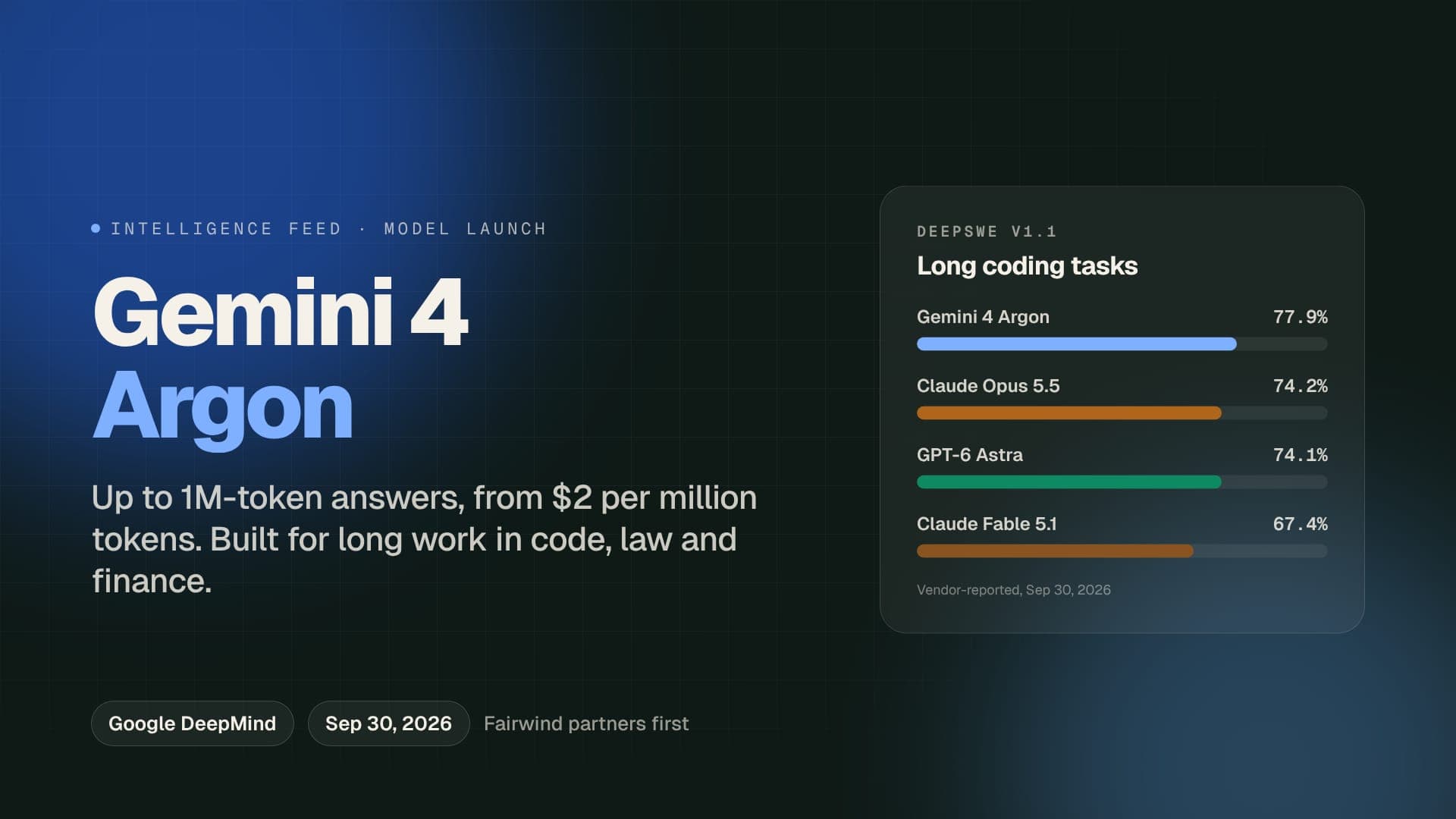
It leads DeepSWE v1.1, a long-form coding test, at 77.9% - ahead of Claude Opus 5.5 (74.2%) and GPT-6 Astra (74.1%). On Terminal-Bench 4.0 it trails both, at 57.4%.
- 03
Its headline spec is output length: Google says Argon can write up to 1 million tokens in one answer, up from 64,000 - roughly 750,000 words.
- 04
It launches at $2 per million input tokens and $10 per million output, rising later to $4 and $20 - but at first only vetted cyber defenders in Google's Fairwind Program can use it.
On September 30, 2026, Google DeepMind announced Gemini 4 Argon, its new frontier model. Google describes it as built to sustain deep reasoning across complex, long-horizon workflows - in plain words, to keep thinking clearly through long jobs with many steps.
It is the third frontier model in four weeks, after OpenAI's GPT-6 Astra on September 3 and Anthropic's Claude Opus 5.5 on September 22. Three things make Argon stand out:
- It leads a major coding test, DeepSWE, at 77.9%.
- It can write up to a million tokens in a single answer.
- It launches at half its later price.
There is a catch: most people cannot use it yet. Here is what Argon can do, what it costs, how it compares, and what it means for your job.
Gemini 4 Argon in 60 seconds
| Question | Short answer |
|---|---|
| Announced | September 30, 2026 |
| Made by | Google DeepMind |
| Built for | Long, multi-step work in software, legal and finance, and cyber defense |
| Google says it excels at | Coding, financial research, legal drafting, patching security holes on its own |
| Longest answer | Up to 1 million tokens, up from 64,000 (Google's figure) |
| Launch price | $2 per million input tokens, $10 per million output |
| Later price | $4 input, $20 output |
| Who can use it now | Vetted cyber defenders in Google's Fairwind Program |
| Who is next | Paid API customers and Google AI Ultra subscribers (no date given) |
What does "1 million output tokens" actually mean?
A token is a small chunk of text, roughly three-quarters of a word. Most AI models can read a lot but only write a limited amount in one go. Google says Argon can write up to 1 million tokens in a single answer - about 750,000 words.
In practice that means one request can produce a very long report, a full set of contract documents or a large body of code, without stitching pieces together. Some independent listings show a lower limit, so treat the million as Google's figure until it is widely tested. Either way, the direction is clear: AI is moving from writing paragraphs to producing whole work products.
The benchmarks, in plain English
Google's headline result is on DeepSWE, a test that hands models long, realistic software tasks on real codebases.
Where Gemini 4 Argon leads: long coding work
DeepSWE v1.1 gives models long, realistic software tasks on real codebases. Higher is better.
- GPT-6 Astra (OpenAI)
- Anthropic
DeepSWE v1.1
Sources: Google's Gemini 4 Argon launch materials (September 30, 2026) for Argon; each lab's published DeepSWE v1.1 results for the other models, as compiled in launch coverage. Vendor-reported, not yet independently reproduced at launch.
At 77.9%, Argon is ahead of Claude Opus 5.5 (74.2%) and GPT-6 Astra (74.1%). Google also reported 91.7% on LVBench, a test of understanding long videos.
It is not a clean sweep.
Where it does not: terminal work
Terminal-Bench 4.0 measures engineering and data work done in a command line. Higher is better.
- GPT-6 Astra (OpenAI)
- Anthropic
Terminal-Bench 4.0
Sources: Anthropic's Claude Opus 5.5 launch page (September 22, 2026) for Claude Opus 5.5 and GPT-6 Astra; launch coverage of Google's figures for Gemini 4 Argon.
On Terminal-Bench 4.0 - engineering and data work done in a command line - Argon scores 57.4%, behind both Opus 5.5 and Astra. At launch these figures came from the labs themselves and had not been reproduced by independent testers, so read every number here as "reported", not proven.
The honest summary: three labs are now within a few points of each other, each leading on different tests. For your career, that matters more than who wins any single chart.
Free · about 30 seconds
Three frontier models in four weeks. How exposed is your job?
Upload your resume and get your AI Job Security Score, the tasks most at risk and the strengths that protect you.
The price: the cheapest frontier model at launch
The cheapest frontier model at launch
US dollars per million tokens. Lower is better. Argon's launch price is introductory; Google says it will rise to $4 and $20.
- GPT-6 Astra (OpenAI)
- Anthropic
Input, per million tokens
Output, per million tokens
Output is where long answers - and long agent runs - spend most of their money.
Sources: Google (Gemini 4 Argon introductory and later pricing, September 30, 2026); Anthropic (Claude Opus 5.5, September 22, 2026); OpenAI (GPT-6 Astra, September 3, 2026).
At $2 input and $10 output per million tokens, Argon launches at half the price of Claude Opus 5.5 and a fifth of GPT-6 Astra's. Cached input - text the model has seen before - is 95% cheaper again. Google says the price will later double to $4 and $20, but it has not said when.
Why should a non-developer care about token prices? Because companies automate a task when AI does it cheaper than a person, reliably enough. Every price cut moves more tasks over that line, even if the model gets no smarter.
Why cyber defenders get it first
Google released Argon first to vetted cyber defenders through its Fairwind Program, which had more than 650 partners at launch.
The reason is one of Argon's headline skills: finding and patching security holes on its own. That is exactly what defenders need - and exactly what attackers would want. Releasing it to defenders first gives them a head start before the model is widely available.
Gemini 4 Argon vs GPT-6 Astra vs Claude Opus 5.5
| Gemini 4 Argon | Claude Opus 5.5 | GPT-6 Astra | |
|---|---|---|---|
| Released | Sep 30, 2026 | Sep 22, 2026 | Sep 3, 2026 |
| DeepSWE v1.1 | 77.9% | 74.2% | 74.1% |
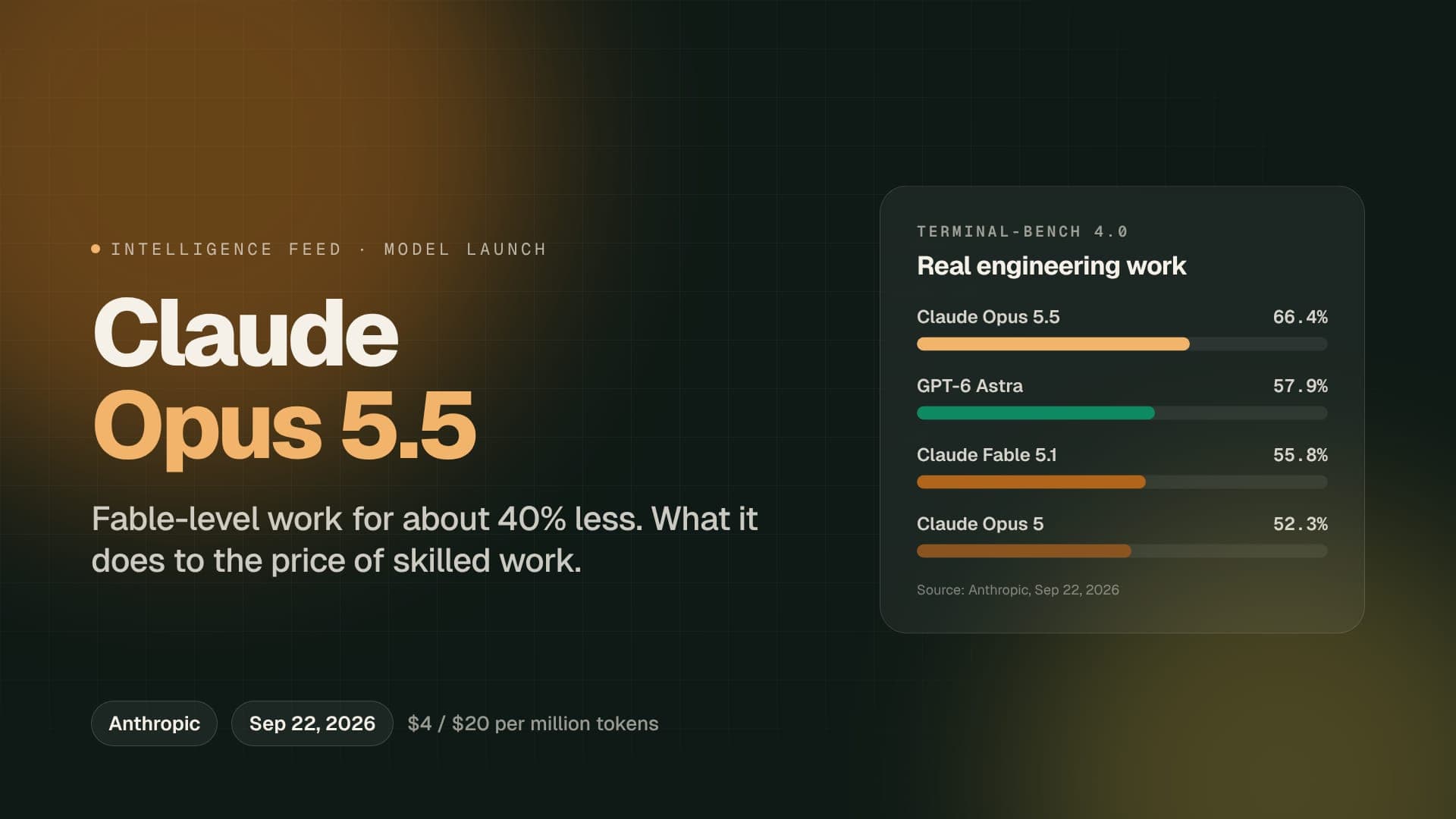
| Terminal-Bench 4.0 | 57.4% | 66.4% | 57.9% |
| Price (input / output) | $2 / $10 at launch | $4 / $20 | $10 / $50 |
| Standout strength | Long coding work, very long answers | Engineering and office work | Science, maths, computer use |
| Who can use it | Fairwind partners first | Everyone on paid plans and the API | ChatGPT paid plans and the API |
What Gemini 4 Argon means for your job
Google named the work Argon is built for, so the exposure map is unusually direct.
| Work pattern | Why Argon targets it | Exposure |
|---|---|---|
| Long coding tasks on real codebases | Leads DeepSWE at 77.9% | Critical |
| Legal drafting and contract documents | Named by Google; up to 1M-token answers | High |
| Financial research and analyst notes | Named by Google | High |
| Security patching and vulnerability fixes | Released first to cyber defenders | High |
| Long reports and technical documents | Writes whole work products in one go | High |
| Advice, negotiation, sign-off and accountability | Not measured by any test here | Lower |
Look at who is on that list: lawyers, analysts, engineers, security specialists. These are well-paid, highly trained jobs - not just routine office work. What is exposed is the production part of them: the first draft, the research pull, the code change. What stays human is deciding what is right, advising the client, and putting your name to it.
What to do this month
- Separate drafting from deciding. Split your work into "producing the document, code or analysis" and "deciding what it should say and standing behind it". The first is what Argon was built for.
- Get fluent with long-output AI. Try a model on a full first draft of something you normally write. Learn where it is strong and where it goes wrong - that checking skill is now part of the job.
- Invest in judgment and trust. Client relationships, professional sign-off and accountability are not on any benchmark, and they are what employers still pay people for.
- Know where you stand. See which of your tasks are most exposed, then build a plan around the strengths that protect you.
Your 6-month plan
Plan your next 6 months before the next model ships
Answer 12 short questions. We research your job market live and write a plan for you, month by month.
Gemini 4 Argon is a strong model, but the bigger story is the pace: three frontier launches in four weeks, each one cheaper or better at real work. The best response is not to guess which lab wins. It is to make sure your own work sits on the side of the line that these models hand back to people.
Applying is 12 minutes of typing you've already done.
Job Autofill fills every application from your saved profile - about 10 hours back over a job hunt.
Professional Defense Strategy
6-Month Strategic Action Plan
If you write long documents for a living - contracts, research notes, technical specs - test what today's models already do with a first draft. Argon was built for exactly that kind of long, structured output.
Software engineers: practise the work around the code. Argon leads on long coding tasks; reviewing, testing, and deciding what should be built are where people stay essential.
Watch the price, not just the scores. Argon launches at half its later price, and three frontier models shipped in four weeks. Cheaper skilled AI widens the set of tasks companies automate.
Check your own exposure. A free AI Job Security Score shows which of your tasks are most at risk and which strengths protect you.
Frequently Asked Questions
What is Gemini 4 Argon?
Gemini 4 Argon is Google DeepMind's new frontier AI model, announced on September 30, 2026. Google built it to keep reasoning through long, multi-step work and says it excels at coding, financial research, legal drafting and autonomous vulnerability patching. Its headline feature is that it can write up to 1 million tokens in a single answer.
How much does Gemini 4 Argon cost?
Google's introductory price is $2 per million input tokens and $10 per million output tokens, with cached input at a 95% discount. Google says the price will later rise to $4 input and $20 output. It has not said exactly when the introductory price ends.
Can I use Gemini 4 Argon now?
Probably not yet. Google first released Argon to vetted cyber defenders through its Fairwind Program, which had more than 650 partners at launch. Paid API customers and Google AI Ultra subscribers are expected next, but Google gave no date at launch.
What is Google's Fairwind Program?
Fairwind is Google's early-access program for trusted cyber defenders - organisations that protect systems and infrastructure. They get Argon first because one of its headline skills is finding and patching security holes on its own, which defenders need and attackers would also want.
Is Gemini 4 Argon better than GPT-6 Astra or Claude Opus 5.5?
It depends on the task. Argon leads DeepSWE v1.1, a long coding test, at 77.9% against 74.2% for Claude Opus 5.5 and 74.1% for GPT-6 Astra. It trails both on Terminal-Bench 4.0, at 57.4% against 66.4% for Opus 5.5 and 57.9% for Astra. It is the cheapest of the three at its launch price. Google's figures were not yet independently reproduced at launch.
What does a 1 million token output mean?
A token is roughly three-quarters of a word, so 1 million output tokens is about 750,000 words in a single answer - enough for a very long report, a full set of contract documents or a large amount of code at once. Google says this is up from 64,000 tokens. Some independent listings show a lower limit, so treat it as Google's figure until it is widely tested.
Will Gemini 4 Argon replace lawyers or financial analysts?
It is aimed squarely at parts of their work: Google names legal drafting and financial research as strengths. First drafts, research summaries and long structured documents are the most exposed tasks. Judgment, client advice, negotiation and signing off with professional responsibility are not what Argon was tested on - and those are where people in these jobs should invest.
Why did three frontier AI models launch so close together?
OpenAI released GPT-6 Astra on September 3, Anthropic released Claude Opus 5.5 on September 22, and Google announced Gemini 4 Argon on September 30, 2026 - three frontier models in four weeks. The labs are close enough at the top that each launch quickly answers the last, which keeps capability rising and prices falling.
Researcher Intelligence
Automation Intensity
90%Overall Substitution Risk
Grounding
Primary Technical Launch
Status
Market Active
"Market saturation for Model intelligence is expected to accelerate significantly following this window."
Land Your First Interview Call Faster.
In the middle of job loss chaos, don't get lost in the pile. Resume Maximiser scores your resume in 30 seconds and shows you exactly why it is being filtered out.